If you are looking for Paul Merrill, go over to Shiny Bits of Life, which is my personal blog - or Greener Grass Media. Thanks!
(I no longer live in Nairobi. But occasionally I do blog about life there at Shiny Bits of Life.)
Sunday, September 27, 2015


Saturday, April 12, 2008
Blog weirdness
 I visited Google Analytics for this site recently. My "Glass!" entry from May 2006 scored an amazing number of hits. It brought my total hits for one day (for any of my sites) to a record level: 381!
I know of no reason for this.
Update: Gill the Bean from the UK let me know that my post was featured via Dooce! Wow, cool!!
Saturday, June 02, 2007
Goodbye to This Glorious Chaos
 It is time for me to say goodbye.
We leave Kenya tonight right before midnight. We have lived here for just over two years - and not left East Africa during that time.
So why do I refer to Kenya as "This Glorious Chaos"? Well, it's glorious here - and very chaotic.
I know that some of the readers out there might object to Kenya being called chaotic. Well, don't be. Nairobi, at least, has lots of chaos. Just get in a car and drive across town!
And the glory? Oh, it's all over the place. Smiles on so many faces. Laughter as I pass roadside shops. Beautiful amazing random artwork on ceramic pots for sale along Ngong Road. Flowers on almost every plant, year around.
So you should come to Africa. Not just to visit - but to live. Then you can really see what life is like. We tried - two years is not long enough. We were compelled to return to our home, America. Those of you who know us understand why. Those who don't - well, you'll just have to get to know us. (Move to Colorado.)
Thursday, May 31, 2007
Didn't succeed
 ...But at least I got a still image.
I had been meaning to get a video of the Kenyan National Anthem - the version played before many movies at cinemas here. My final attempt did not succeed; I only got about 1 second.
It's interesting to watch that short film - it's the same edition that has been used for maybe 30 years. (Or it seems like that.)
Wednesday, May 30, 2007
International-ness
 As we will be returning to the States so soon, I have pondered some of the things I'll miss.
One is the international aspect of life in Nairobi. Most places we go are frequented by people from all over the world.
And the organization I work with is a picture of that also: at our weekly prayer meeting recently, I looked around the room. There were 10 Americans, 6 Kenyans, 5 Brits, 2 New Zealanders, 1 Swiss(er) and 1 Canadian.
Littleton, Colorado is not like that.
And yes, it's another photo that has nothing to do with the post. I just love cars. Even ones that have their body parts held on with straps.
Tuesday, May 29, 2007
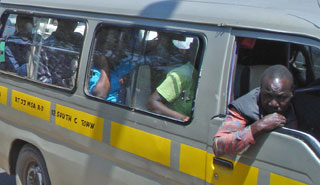
14 seats
 Matatus are mini buses that travel all over Kenya. In early 2005, the government changed their policies on matatus. Before, if an operator wanted to cram 300 people into the minibus, that was alright. No longer. (A great change!) 14 passengers is the max - and seatbelts are required by law for all 14. Moms frequently carry their kids on their laps (beyond the 14 rule) - but that's another story.
The government will be phasing out the 14-seaters, but that's yet another story.
"Matatu" in Swahili means that you could travel for 30 cents, a standard fare wherever and whenever you went: three 10 cent coins. (Special thanks to my friend toneloc who gave me the truth on that!)
Monday, May 28, 2007
Leaving
 1. Absence makes the heart grow fonder
2. Deprivation breeds appreciation
These are two concepts that have been rattling around in my brain as I have contemplated leaving this Kenyan life and starting a new life in the States. Much of my old life is gone - I will not be returning to my old job. (Marti Smith, a former co-worker, is grieving this loss too.) But we are very thankful to be returning to some of our familiar friends and our beloved home.
Leaving here means saying goodbye to friends. A sad reality.
As you may have noticed, my photo does not illustrate all this.
Subscribe to:
Posts (Atom)
-
Today I have a guest photographer - Josh Cadd. He and his family moved to Nairobi about six months ago. Part of getting settled meant buying...
-
 It is time for me to say goodbye. We leave Kenya tonight right before midnight. We have lived here for just over two years - and not left Ea...
 -
 Matatus are mini buses that travel all over Kenya. In early 2005, the government changed their policies on matatus. Before, if an operator ...
